
The Decommissioning Problem - What Happens to Offshore Wind Farms When Nature Has Moved In?
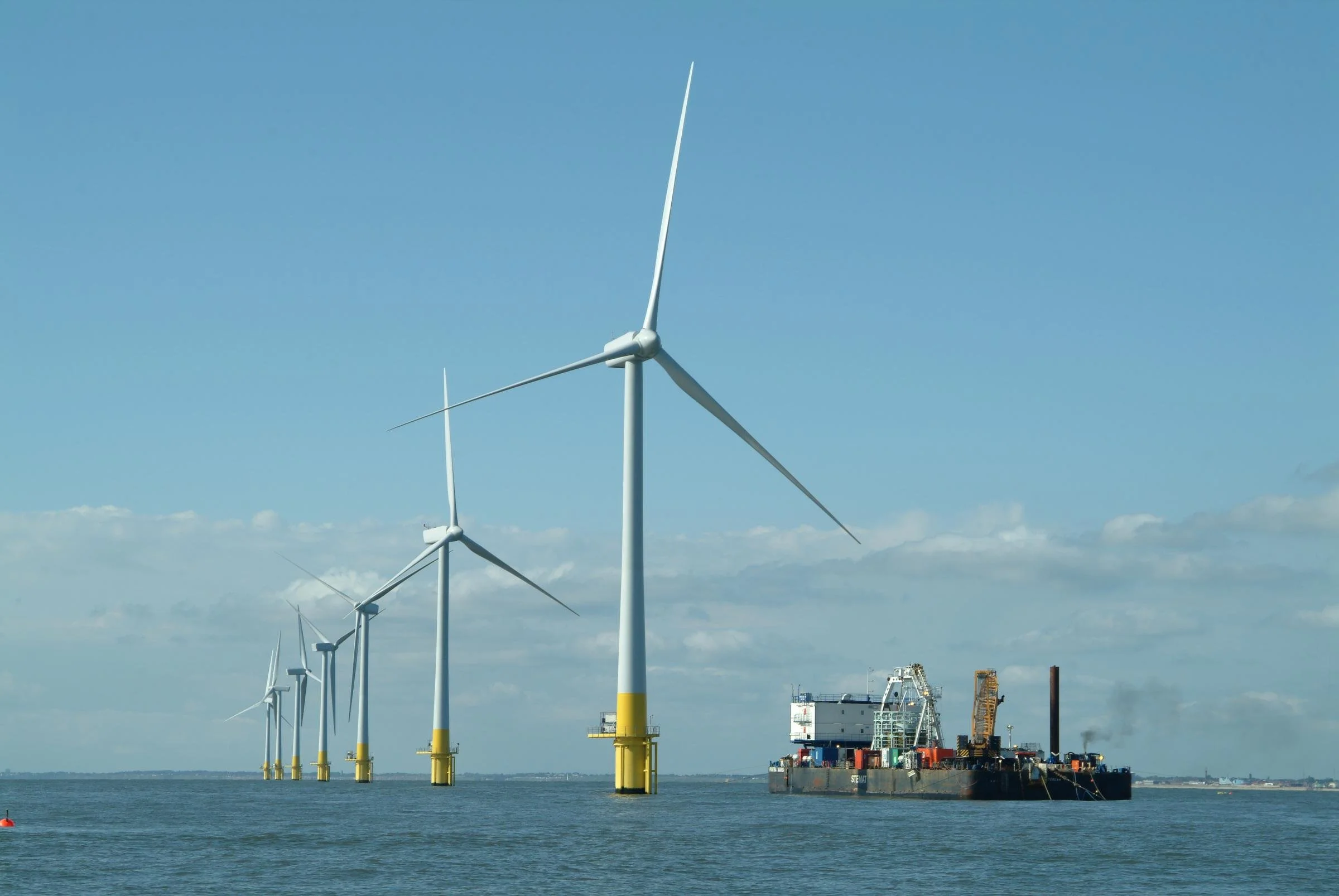
Scroby Sands Wind Farm
Offshore wind has been placed as a major player in the renewable energy transition. However, a new phase of the industry's lifecycle is now arriving, and it's one policy hasn't fully caught up with yet, that being “decommissioning”.
Many of us know there is already a lot of attention on the topic, and most of us in the industry have an opinion on it. What's far less settled is the policy that should govern best practice. As the earliest generation of offshore wind farms reaches the end of its operational life, that gap is becoming harder to ignore, especially now that Nature-Inclusive Design has changed what these structures actually mean for marine biodiversity.
Decommissioning for many offshore windfarms is imminent
Blyth, the UK's first offshore wind farm, was fully decommissioned in 2019. The two-turbine, 4MW demonstrator project was commissioned back in December 2000. Its removal, carried out by E.ON, marked the UK's first full offshore wind decommissioning and offered an early, if at a small scale, gives a glimpse of what lies ahead for the rest of the fleet.
The next major test case is already underway. Scroby Sands, located 2.5km off the coast of Great Yarmouth in Norfolk and operated by RWE, was commissioned in 2004. The 60MW site comprises 30 Vestas V80 turbines and generates enough electricity to power more than 48,000 homes. Full decommissioning of the site is expected around 2030, with some industry reporting suggesting the wider retirement window could stretch as late as 2031.
One turbine has already come down ahead of schedule. In August 2023, a fire broke out in the nacelle of turbine T06, causing damage severe enough to take it permanently out of operation. Removal work on the nacelle, blades and upper tower section began in 2025 using a jack-up barge, with the components taken ashore to the Port of Great Yarmouth for recycling. However, no work has yet been carried out on the foundation itself. That decision has been deferred, which is precisely the kind of question the rest of this blog is about.
Scroby Sands won't be alone for long. Larger, later generation sites with much larger turbines are also approaching end-of-life. This means that the sector is about to face a wave of decommissioning projects, competing for the same limited pool of specialist vessels, ports and contractors that are simultaneously needed to build new capacity.
The foundation question nobody has fully answered
If things weren’t challenging enough, the offshore turbine foundations (monopiles, jackets, or gravity bases) are engineered to be extremely stable, which makes them extremely hard to remove. What should happen to them once a wind farm reaches end of life is currently one of the most contested questions in the sector.
The starting point in international and regional law leans firmly toward full removal. Article 60(3) of the UN Convention on the Law of the Sea and OSPAR's Decision 98/3 on the Disposal of Disused Offshore Installations (as amended by Decision 2024/01) both set complete removal as the default expectation for decommissioning offshore infrastructure in the North-East Atlantic. That default was shaped in large part by the offshore oil and gas sector, where a "clean seabed" approach has long been the guiding principle.
However, offshore wind isn't oil and gas, and the guidance hasn't fully adapted to that difference. There's considerable inconsistency in how "full removal" is even interpreted, with some operators and contractors working to monopile removal depths of two metres below the seabed; others work to five. Legislation in several jurisdictions specifies six metres. There's similar ambiguity around scour protection, which is placed around monopile bases to prevent erosion. Many pose the question of whether this counts as part of the installation that must come out.
This lack of clarity has real consequences for the ecosystems that have developed on and around these structures over the past two decades.
Where Nature-Inclusive Design complicates the picture
Offshore wind turbine foundations don't stay bare steel or concrete for long. Over years and decades following installation, they become home to a variety of marine species. Increasingly observed using these king of structures are mussels, anemones, soft corals and a wide range of fish species that use the hard structure as habitat in what is often a soft-sediment seabed environment. Where Nature-Inclusive Design has been deliberately built into these structures through textured surfaces, retrofitted habitat panels, or features designed to boost surface complexity, that colonisation is even more pronounced and more valuable.
It begs the question however, what's the point of designing habitat into offshore infrastructure if regulation then requires developers to strip it all back out at end-of-life?
Research and industry commentary increasingly point to this tension. A "clean seabed by default" policy, applied uniformly, risks undoing years of ecological establishment and causing a fresh round of physical disturbance to the very habitats Nature-Inclusive Design was meant to protect. Some stakeholders argue for partial decommissioning, where foundations are left in place, or at least scour protection, where they now support established reef communities. Potential benefits like reduced disturbance, retained ecosystem services, and even a deterrent to seabed-damaging activities like trawling in that area going forward are certainly points for consideration.
Others push back hard on that front. Many are concerned that it sets the precedent for treating the seabed as a place to leave structures rather than restore, uncertainty over long-term structural degradation, and a hesitancy about normalising "unnatural" permanent additions to marine environments, however well intentioned. Survey based research into public and stakeholder attitudes suggests that people's risk tolerance strongly shapes where they land on this question, and that current policy defaults, which are rooted in the principle of leaving the seabed as it was found, don't yet reflect the more structure-specific reality that habitat colonisation has created.
A regulatory gap the sector can't afford to leave open
What's become increasingly clear is that decommissioning strategy is being decided too late in the process. Rarely is decommissioning planned for at the consenting stage, and is more commonly considered when a site nears end-of-life. That leaves operators, regulators, and environmental stakeholders negotiating expectations and liabilities under time pressure, with limited flexibility to weigh options like partial removal, seabed clearance short of full extraction, or lifetime extension.
If Nature-Inclusive Design is going to keep expanding across offshore energy infrastructure, decommissioning policy needs to catch up. That means:
Clear, harmonised definitions of what "full removal" actually requires, including consistent depth thresholds and treatment of scour protection,
Site-specific ecological assessment built into decommissioning planning, so that established habitat value is actually weighed against removal rather than defaulted away,
Earlier engagement, ideally at the consenting stage so that end-of-life strategy isn't an afterthought bolted on decades later,
A credible pathway for partial retention, with clear liability and monitoring frameworks for cases where leaving structures in place is the better environmental outcome.
The bigger picture
Offshore wind farms were never meant to be permanent fixtures on our coastlines and seabeds. Despite this, many have become something more than power infrastructure over their operational lifetimes. They're now functioning marine habitats, and in cases where Nature-Inclusive Design has been applied, deliberately so.
As Blyth and Scroby Sands mark the start of a much larger decommissioning wave across the UK and Europe, the industry has a narrow window to get this right. Getting it wrong doesn't just mean higher costs or logistical headaches, it means potentially undoing exactly the kind of ecological gains that Nature-Inclusive Design set out to achieve in the first place.