
Meet the OysterForest | Oyster Restoration

OysterForest™ Prototype
Introduction - Oyster Restoration
Oyster restoration has gained much attention in recent years as we seek to restore our lost seabed habitats and mitigate against the impacts of climate change. Our native species is the European flat oyster. Described as ecosystem engineers, they provide a range of ecosystem services, including water filtration, removing pollutants and excessive nutrients from seawater. In addition, they naturally form complex reef structures as many generations of oysters stack upon each other. These reefs form natural wave breaks, protecting against storms and tidal surges, as well as providing habitat for a vast array of marine life. Native oysters were historically widespread around the coastlines of North Sea countries, covering 20-30% of the North Sea, but their chronic over-exploitation and susceptibility to other pressures such as parasitic diseases has contributed to their decline.
Rationale - Living Windfarms Project
Under the Living Windfarms Project, Exo Engineering wanted to develop a solution for native oyster restoration. Rather than just deploying native oysters into the sea, we also wanted to use Nature-Inclusive Design to provide additional habitat through enhancement of surface texture and provision of hole habitats for additional mobile benthic species, such as crabs and lobsters. Not only this, but we wanted to maximise the types of materials used to deploy native oysters and began to explore whether it would be feasible to encourage native oyster to settle on wooden branches.
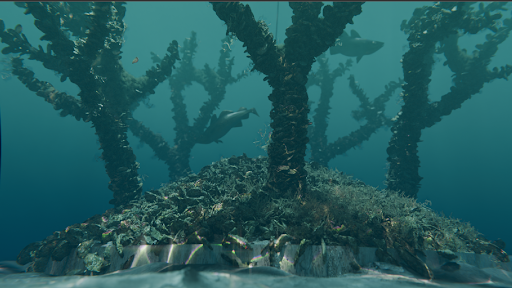
OysterForest™ Visual Mock-up Render
Why Incorporate Wood?
Wood has historically been a natural structural component of coastal and estuarine ecosystems, where fallen trees and large woody debris contributed to habitat complexity, sediment retention and ecological productivity. In this context, the branches can also form a natural framework on which the oysters can settle. Combining these concepts, the result is a Nature-Inclusive Design which provides an impressive variety of habitats for marine species, whilst also targeting native oyster restoration.
Literature Review
The first stages of the project involved literature reviews into previous research and the characteristics of different wood types which may be suitable for native oysters to settle upon. Several important characteristics were determined, including wood density (and therefore vulnerability to predation by shipworm and other marine borers), tannin content (which would deter native oyster settlement), and avenues for sourcing the wood, with a preference for sourcing waste woods rather than virgin wood.
Wood Treatments
Another important consideration was preparation of the wood, with literature research suggesting that a lime-based coating was likely to encourage native oyster settlement, as this provides a calcium-rich surface that mimics natural shell chemistry, encouraging oyster settlement. Crushed oyster shell was also incorporated into the lime, to further encourage native oyster settlement, as this provides further chemical and structural settlement cues.
Laboratory Testing Of Wood Types
Laboratory testing was also conducted into the different wood types, in collaboration with the University of Essex. This included using photo spectrometry to assess the tannin content of the wood of several tree species native to the UK, as well as conducting both laboratory and field-based experiments on preferential settlement of oysters and other marine organisms on the different wood types.
Nature-Inclusive Concrete Base
It was also important to consider how the branches would be fixed into the Nature-Inclusive concrete base, as we theorised it would not be feasible to submerge the entire unit in an oyster settlement tank. It was therefore decided that the branches would be cast into a small concrete plug which could be positioned into the base following spatting and fixed into position using a marine-grade natural cement. This is much more manageable for transporting the branches, settled with juvenile oysters, to a deployment site where we can fix the branches into the base in situ. This approach reduces the risk of damage during transportation, and enables us to keep the juvenile oyster submerged, or in a damp environment, for as long as possible to achieve the best chances for minimising oyster spat mortality.
Deployment & Conclusion
OysterForest™ is a scalable Nature-Inclusive Design concept for native oyster restoration, using sustainably sourced branches as a settlement scaffold for juvenile oysters. Developed under the Living Windfarms Project with research support from the @uniessex, the concrete base also provides habitat for crabs, lobsters and sea snails. This test prototype deployment at Wells-next-the-Sea, North Norfolk, shows the structure in place ahead of oyster settlement.
We named the new product the OysterForest™. A prototype unit was cast at the end of May, with a test deployment taking place in July. Weighing 500kg, the prototype is smaller than the intended full-size unit but informed us that the concept we had developed could indeed be produced as intended, and the design can be scaled to meet the requirements of the deployment location. The next step is sourcing native oysters to settle on the wooden elements of the Nature-Inclusive Design. This has proved challenging due to the excessive demand currently being experienced by native oyster hatcheries, coupled with limited oyster spat production. The prototype relies on natural oyster settlement, encouraged through the use of enhanced surface textures and of the calcareous coating. However, by settling oysters on the wooden branches in advance, we give them a healthy head start, allowing the OysterForest™ to form the basis of a thriving natural reef in years to come.