
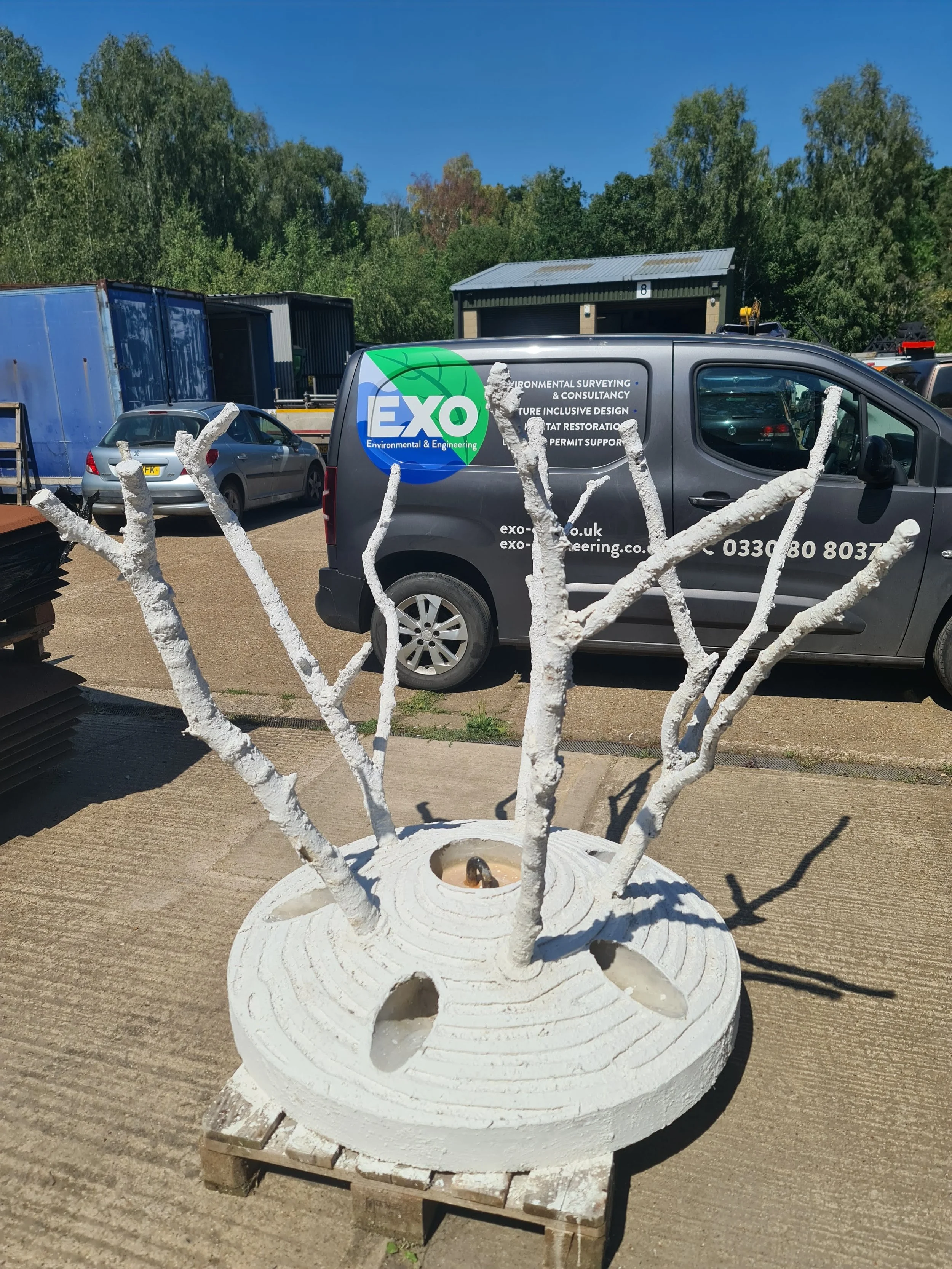
OysterForest™ Finished Prototype With Shell-Like Skin
When you picture an artificial reef, wood probably isn't the first material that comes to mind. Concrete blocks, steel frames and moulded modules dominate the sector, and these similarly form the backbone of many of Exo Engineering’s Nature Inclusive Designs. But for our new OysterForest™, we’re exploring a different approach, and the use of wood is central to our design. However, getting the choice of timber right has taken real research.
The Case For Wood
Wood has been used to attract marine life for centuries. Sunken branches and woody debris naturally create the kind of complex, textured surfaces that biofilms, invertebrates and fish are drawn to far more than a flat, featureless surface ever could. It's renewable, low-carbon, and, when sourced well, genuinely circular.
That last point matters a lot to us. Rather than using virgin timber, we wanted to ensure that our OysterForest™ structures make use of either waste sources from renewable forestry, or by using coppiced hardwood, harvested through traditional UK woodland management. Coppicing is a rotational cutting practice that keeps woodlands productive and biodiverse, and it produces a steady supply of wood that would otherwise often end up as firewood or fencing. Using this material means we're not competing with commercial timber markets, and we're supporting sustainable land management as a side benefit of building reefs.
Narrowing Down The Field
We started by reviewing a long list of UK hardwood and softwood species that could realistically be sourced through coppicing or low-value forestry by-products. Not every species is equal for this job, though. Hardwoods generally resist marine woodborers, like shipworm and gribbles, far better than softwoods, thanks to their density and natural chemistry. But there's a balancing act: some of the compounds that make wood durable can also make it less attractive to the very oysters we're trying to help settle. Working out which species strike the best balance between durability and settlement-friendliness has been a key focus of our research. Each candidate wood species was assessed against a range of factors, and, just as importantly, whether it could actually be sourced at scale without competing with existing timber markets or relying on a species under environmental pressure. That last point ruled out a few otherwise promising candidates early on, either due to supply-chain risk or because the species is more valuable used elsewhere.
This desk-based work narrowed a long list down to a shortlist we carried forward into laboratory and field testing.
Testing In The Lab
Of the wood properties that our desk-based studies uncovered, the tannin content of the wood required some further research. Tannins are natural defensive compounds found in wood and bark, and while they help protect timber from decay, they can also produce chemical cues that put oyster larvae or other marine species off settling in the first place. To get real data rather than relying on published averages, we worked with the University of Essex to extract and measure tannin concentrations from our shortlisted species using laboratory spectrophotometry, a technique that measures how much light a compound absorbs to determine its concentration. This let us see how much variation there was between species and gave us a much firmer basis for selection than desk research alone.
We also ran a controlled settlement trial in the lab, using barnacles as a stand-in for oysters. They behave similarly enough, settling permanently on hard surfaces via chemical cues, to be a useful proxy, and were easier to source reliably for a timed trial. The first attempt actually failed as the untreated wood leached natural sugars and tannins into the water, which encouraged unwanted bacterial growth and meant no larvae survived to settle. Rather than a dead end, this told us something genuinely useful. That green wood may need to be treated before being placed in oyster settlement tanks in a hatchery setting. We've since factored this into our approach, and the repeat trial has had much better results.
Giving Timber a Shell-Like Surface
Oyster larvae are picky. They're naturally drawn to calcium-rich, shell-like surfaces, not bare wood. So, alongside species selection, we've focused on coating our timber with a lime-based layer that mimics the chemistry of a natural oyster bed.
We've trialled different lime types and application methods to find a coating that adheres well to bark and timber, cures safely (lime is highly alkaline until it fully carbonates, so timing matters for marine life), and stands up to months underwater without flaking away. Adding crushed shell into the mix has also proven a promising way to boost both surface texture and the settlement cues larvae respond to.
Testing In The Real World
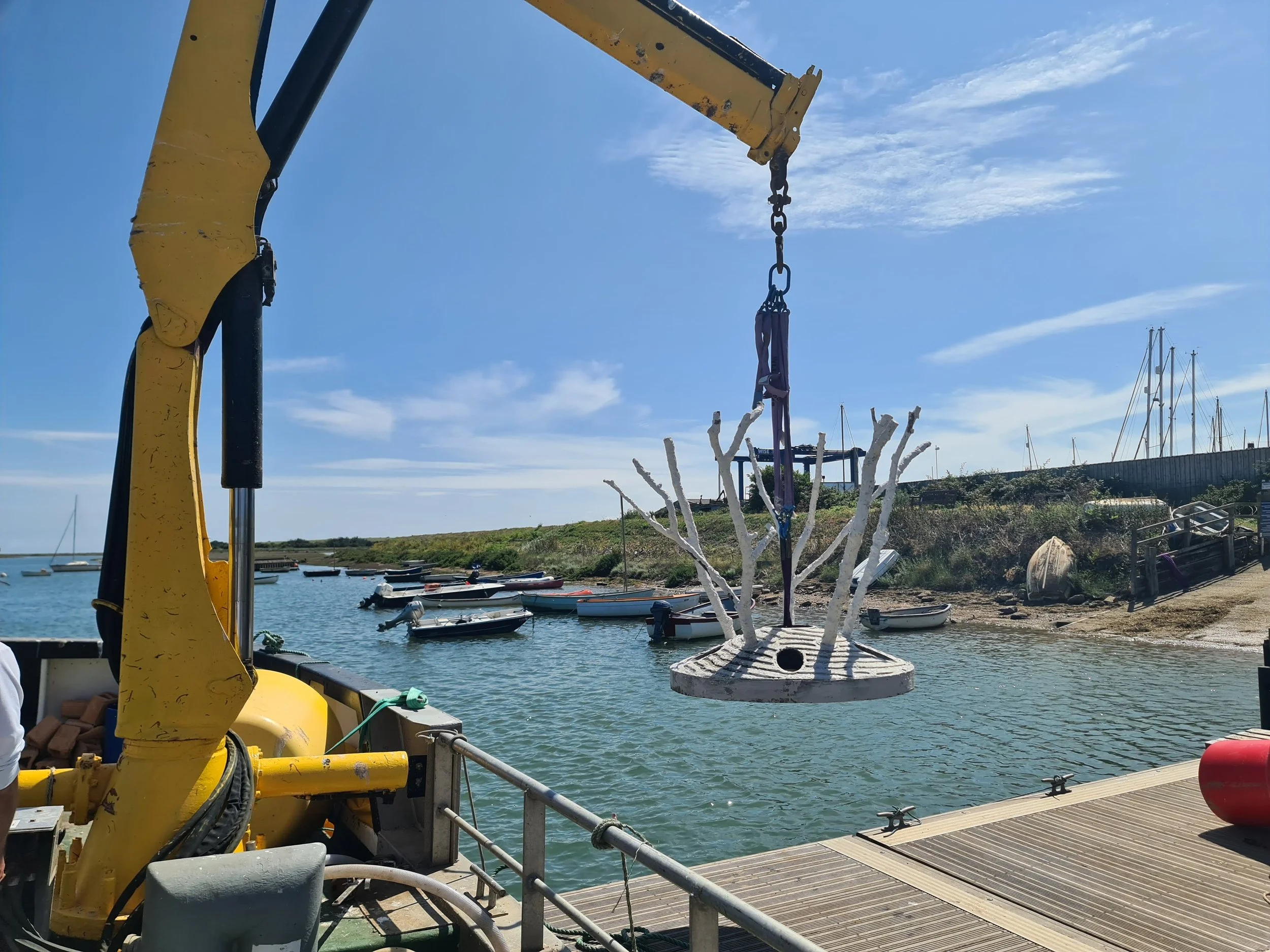
OysterForest™ Deployment Test at Wells 20/07/2026
Alongside the lab work, we deployed branch samples from our shortlisted species at a working harbour site with an established population of both Pacific and native European flat oysters. Here we have been testing both wood species, as well as lime coatings, over the course of the summer, and the samples were submerged and left to colonise naturally. We've been recovering and surveying these samples on a regular cycle, recording what settles on each surface as a percentage of the area covered, a method that lets us fairly compare branches with natural variation in shapes and sizes. This is giving us a real, months-long picture of how different species and surface treatments perform under actual tidal and seasonal conditions, not just in a controlled tank.
In Conclusion
Combining what we've learned from the desk research, the lab trials and the ongoing field data, we've settled on a shortlist of wood species and a coating approach for our OysterForestTM, that balances our requirements for sustainable sourcing, durability, and oyster-friendliness. We're keeping the specifics under wraps for now, but we're excited about what the results are showing so far. Our small-scale prototype has been recently tested in the marine environment, and we’re excited about our future plans to scale up our designs to incorporate them within offshore infrastructure. Watch this space for more updates on the project in the coming months!