
Living Windfarms Project workshop: Where is the Data?
On Thursday 6th of February, we were joined by project partners TotalEnergies EP Nederland and The Rich North Sea for our first Living Windfarms Project workshop of 2025.
The online workshop highlighted the challenges for collecting and sharing data in the marine environment, with specific focus on the relationship between offshore wind and biodiversity. One of the big data challenges is the lack of agreement around baseline biodiversity in the North Sea, and the degree to which we should attempt to restore this.
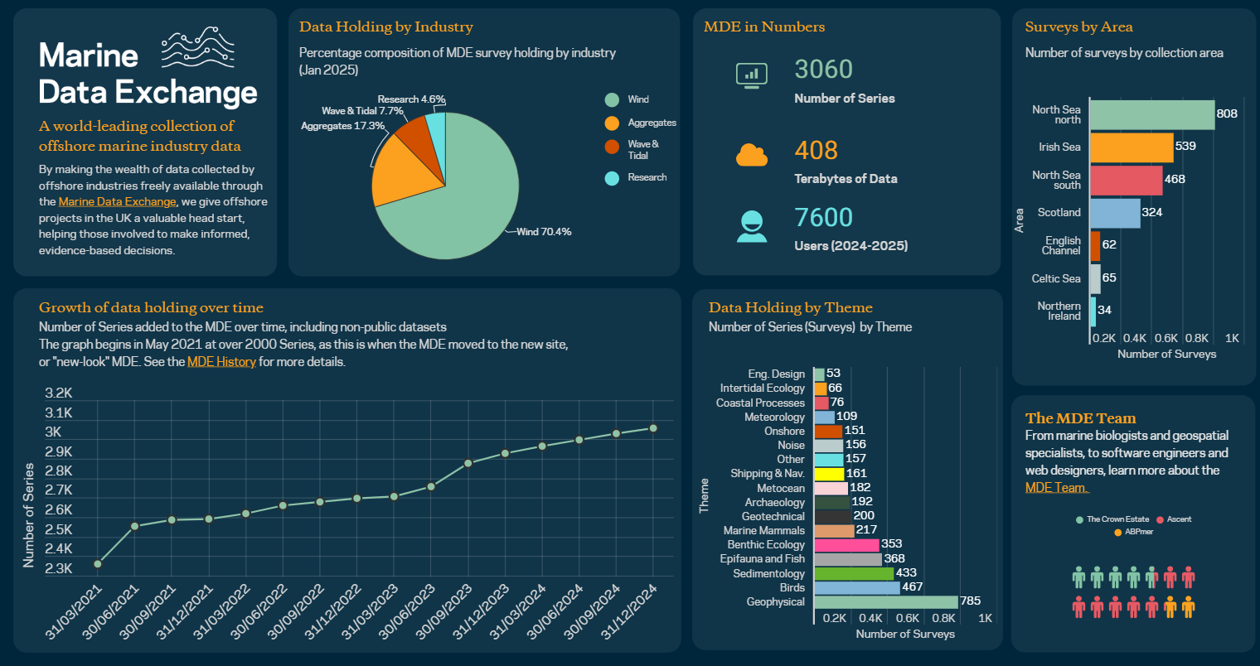
Marine Data Exchange tool, developed by the Crown Estate
Various tools and platforms have been developed to promote the sharing of data. We were fortunate enough to be joined by Harry Richardson from the Crown Estate, who introduced one of these tools: the Marine Data Exchange. Established in 2013, the tool covers the whole of the UK and holds accessible data ranging from feasibility studies to decommissioning.
The Rich North Sea (Derijke Noordzee) introduced another of these data sharing platforms, The Toolbox, developed to inform nature enhancement within offshore wind farms. Their presentation emphasised the importance of striking a balance between human use of the North Sea and wildlife protection.
Nature Inclusive Design has been recognised as a way to achieve our offshore infrastructure development goals whilst also providing habitats for marine species. Exo Engineering shared some of our latest developments, such as the deployment of bespoke artificial reefs in the Dutch North Sea, deployed in collaboration with TotalEnergies EP Nederland. These will be key to gathering vital data about the impacts and benefits offered to biodiversity through Nature Inclusive Design and supporting evidence-based decision making.
Project partner TotalEnergies EP Nederland also delivered a presentation which provided a crucial industrial perspective into the need for streamlined data sharing to support evidence based approached to marine developments.
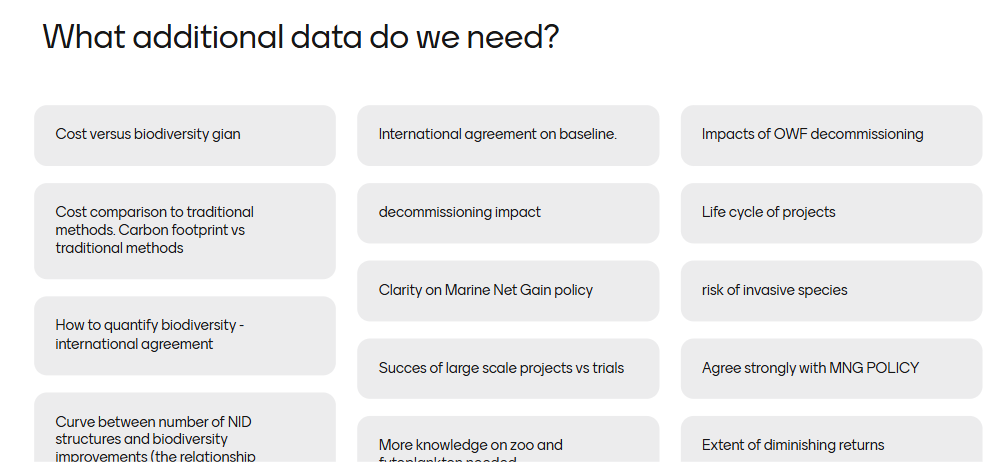
Example responses from the interactive Mentimeter session of the workshop
Many additional considerations were put forwards during the final, interactive portion of the workshop.
This included the need for adopting a standardised way of collecting and presenting data, discussions around which types of data are most important to support decision making, and how we can maximise the usefulness of this data by making it publicly accessible.
A special thanks to all who joined us in hosting the Living Windfarms Project, and to those who joined us on the webinar. We’ve got more workshops planned for 2025, so keep an eye out if you’d like to join the discussion next time.