
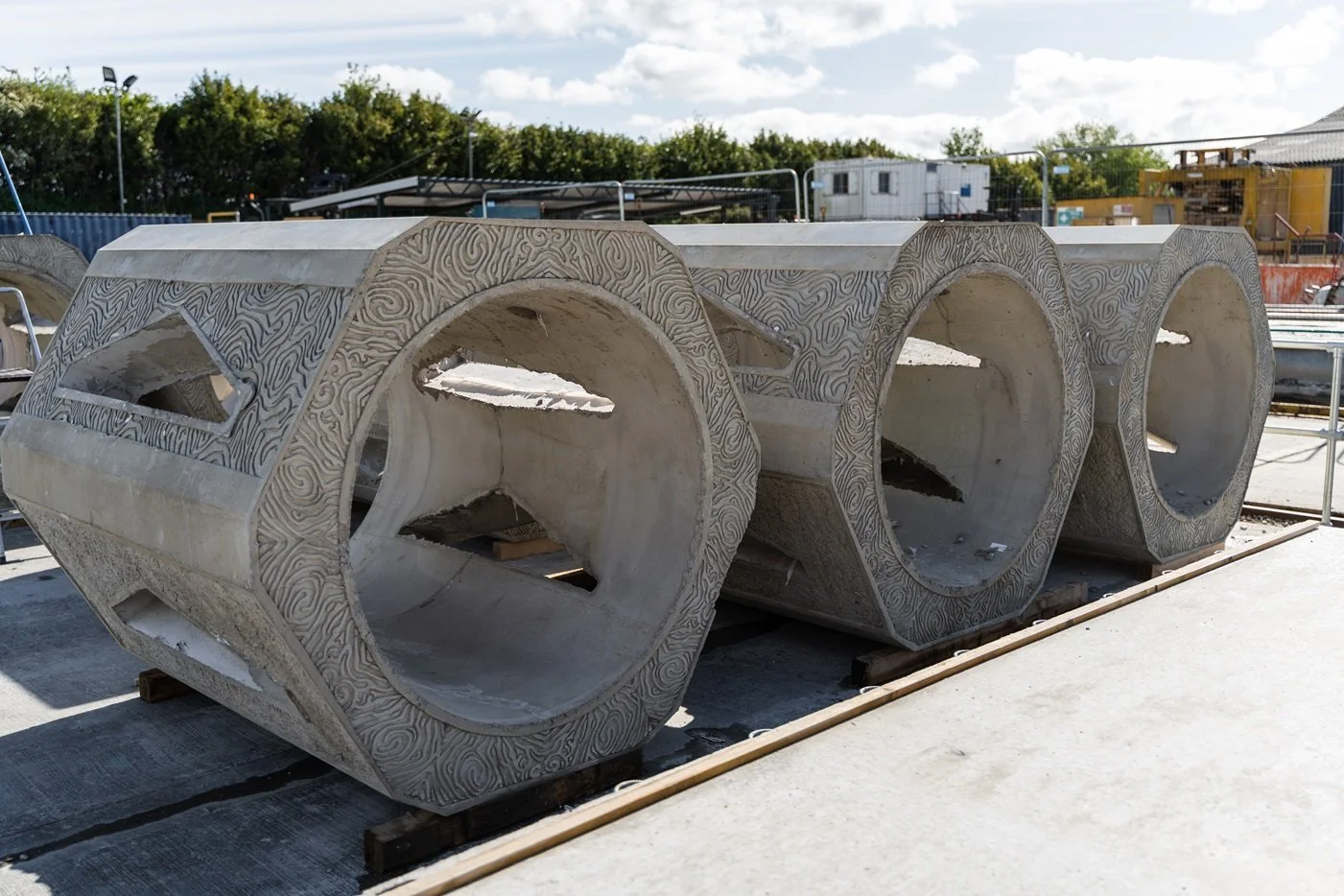
ExoLodges Prior To Deployment
Introduction
The offshore energy industry is entering a new era. As governments and operators accelerate the transition to renewable energy, there is increasing recognition that offshore infrastructure should not only generate clean energy but also contribute positively to marine ecosystems.
Artificial reefs and Nature Inclusive Design (NID) are emerging as practical solutions that allow our offshore development to deliver ecological value alongside their operational purpose. However, despite growing interest, there remains limited long-term evidence demonstrating how Nature Inclusive Design performs in real offshore environments.
To address this challenge, Exo Engineering partnered with TotalEnergies EP Nederland, Living Windfarms, The Rich North Sea (De Rijke Noordzee) and the Offshore Wind Growth Partnership (OWGP) to develop, manufacture, deploy and monitor a series of innovative artificial reef structures in the Dutch North Sea.
The project represents a comprehensive real-world evaluation of Nature Inclusive offshore infrastructure, combining engineering innovation with long-term ecological monitoring to understand how carefully designed habitats can enhance biodiversity around existing offshore assets.
The Challenge
The North Sea has been shaped by decades of offshore oil and gas extraction, as well as prolific overfishing. While traditional infrastructure often becomes colonised by marine organisms over time, it hasn’t been deliberately designed with biodiversity in mind; in fact, quite the opposite, with the use of anti-fouling paints often being used to prevent compromising the structure.
At the same time, governments, regulators and developers are increasingly seeking methods to improve the ecological performance of offshore projects. The challenge is not simply to create additional hard substrate, but to engineer habitats that actively encourage a wider diversity of species while remaining practical to manufacture, deploy and monitor.
The Living Windfarms project set out to answer several important questions:
Can Nature Inclusive Design significantly improve biodiversity around offshore infrastructure?
Do engineered habitat features provide measurable ecological benefits beyond conventional concrete structures?
Can biodiversity monitoring be integrated into routine offshore operations without creating significant additional cost?
How do marine communities establish and evolve during the first years following deployment?
Answering these questions required far more than simply placing artificial reefs on the seabed. It demanded an integrated engineering and scientific programme capable of generating robust, long-term ecological evidence.
Developing the ExoLodge
At the centre of the project is the ExoLodge, an artificial reef developed specifically for offshore deployment.
Rather than functioning as a simple concrete block, the ExoLodge incorporates a wide variety of habitat features intended to support different marine species throughout their life cycles.
Each 4.8-tonne unit measures 1.8 metres in length, and 1.6 metres in both width and height. Key feature of the ExoLodge include:
A large central tunnel providing shelter for fish and crustaceans.
Multiple interconnected voids to improve water flow, and provide additional crevices and ledges for .
Small refuge holes for crustaceans like crabs and lobsters, especially juveniles.
Highly textured concrete surfaces to encourage biological colonisation of sessile species, such as barnacles and sea anemones.
Timber and steel habitat panels, providing a variety of materials which support different fouling communities. These are also raised, providing additional sheltered habitat space behind the panels.
Removable reef plugs allowing detailed scientific analysis without disturbing the overall structure.
Five ExoLodge units were manufactured using two different concrete formulations to allow future comparisons of material performance, while one unit also received a lime coating to investigate whether surface chemistry influences colonisation over time.
Alongside the ExoLodges, a standard ExoAnchor concrete sinker was deployed to act as a control structure, enabling researchers to distinguish between the benefits provided simply by additional hard substrate and those created by the ExoLodge's Nature Inclusive features.
Deployment in the Dutch North Sea
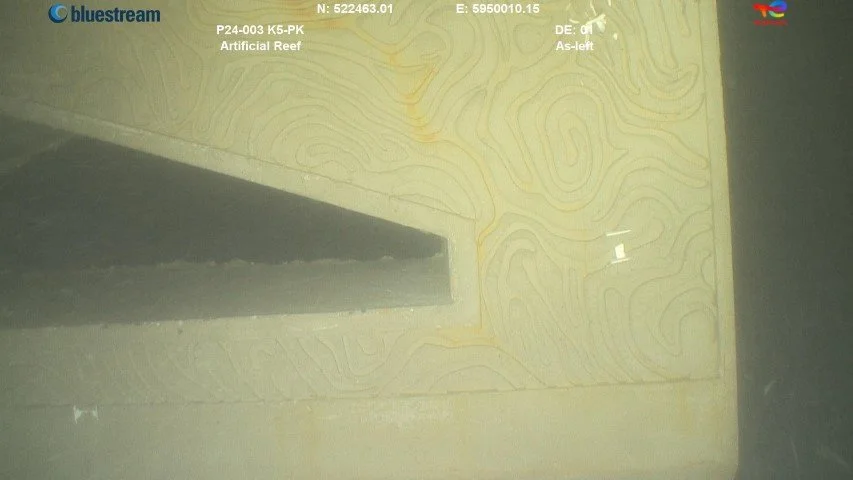
ExoLodge Immediately Following Deployment, Highlighting the Surface Textures and Additional Voids
The pilot was deployed adjacent to one of TotalEnergies EP Nederland's disused gas platforms in the Dutch North Sea.
The location offered an ideal test environment. Installed almost 35 years ago, the platform already supported a mature marine community, providing an excellent benchmark against which newly deployed structures could be compared.
During July 2024, five ExoLodge units and the control block were installed on the sandy seabed approximately 40 metres below the surface using a work-class Remotely Operated Vehicle (ROV). Careful positioning ensured that each structure could be monitored consistently throughout the planned five-year study while remaining fully integrated within existing offshore maintenance activities.
One of the key objectives was to demonstrate that ecological enhancement could be incorporated into normal offshore operations rather than requiring dedicated vessel campaigns. By aligning biodiversity monitoring with TotalEnergies' routine ROV inspection programme, the project established an efficient model for long-term environmental assessment.
Building a Comprehensive Monitoring Programme
Understanding ecological change requires more than occasional observations. For this reason, the project combines several complementary monitoring techniques, each capturing different aspects of biodiversity. High-definition ROV surveys provide visual records of fish, crustaceans and larger sessile organisms colonising the structures. Environmental DNA (eDNA) sampling detects species through traces of genetic material suspended within seawater, allowing researchers to identify organisms that may not appear during visual inspections.
Perhaps the most innovative element is the removable reef plug system. Small sections of each ExoLodge can be recovered during routine inspections and analysed in the laboratory, allowing scientists to identify tiny colonising organisms that cannot be reliably observed using video alone. Together these methods provide a far more complete understanding of ecosystem development than any single survey technique could achieve independently.
Establishing the Baseline
Immediately following deployment, baseline biodiversity surveys were undertaken to establish ecological conditions before significant colonisation of the ExoLodges had occurred. ROV surveys recorded twenty-three species across the platform and surrounding seabed, including numerous fish, crustaceans, anemones, sponges, bryozoans and ascidians. Environmental DNA analysis expanded this picture considerably, detecting additional fish, invertebrates and even harbour porpoise within the wider area. This baseline established an essential reference against which all future monitoring could be compared, allowing changes in biodiversity to be attributed confidently to the developing reef structures rather than natural variation within the surrounding environment.
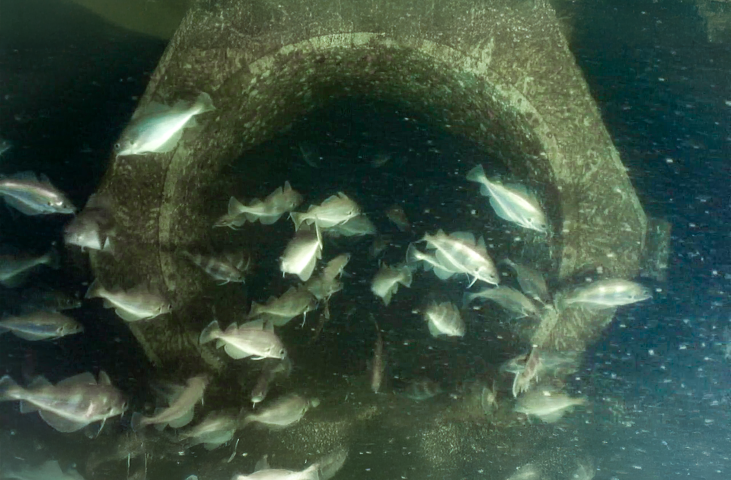
ExoLodge After 1 Year
One Year Later
The first full monitoring campaign took place approximately twelve months after deployment. Even at this relatively early stage, the results were extremely encouraging. Across all monitored locations, researchers recorded twenty-eight species during ROV surveys, representing an increase over the original baseline.
The ExoLodges themselves supported twenty-one recorded species, with an average of almost thirteen species per reef. One structure supported eighteen individual species—only one fewer than the mature platform jacket despite having been underwater for just a single year. Statistical analysis also demonstrated that the communities developing on the ExoLodges were significantly different from those found on the surrounding seabed or control structures. Rather than simply becoming another concrete surface, the artificial reefs were already developing into distinctive ecological habitats.
Engineering That Marine Life Actually Uses
One of the most striking outcomes of the monitoring programme was the way different species selected different elements of the ExoLodge design:
Large shoals of pouting and poor cod were frequently observed sheltering inside the central tunnel.
European lobsters occupied the larger internal voids, while edible crabs used triangular recesses and smaller refuge holes distributed throughout the structure.
Velvet swimming crabs consistently favoured the raised metal panels beneath which they could shelter.
Sessile organisms also demonstrated clear habitat preferences.
Barnacles colonised textured concrete and timber surfaces, while colonial sea squirts showed a strong preference for wooden habitat panels.
Plumose anemones established themselves throughout the large central tunnel, whereas orange anemones were predominantly associated with specially textured "brain coral" surfaces.
These observations demonstrate that biodiversity enhancement is not simply a function of adding hard substrate to the seabed. The complexity, geometry and material variation designed into the ExoLodge appear to be encouraging a wider range of ecological niches capable of supporting different communities simultaneously.

Removable Reef Plug Atop an ExoLodge After 1Year
Looking Beyond What the Camera Can See
The removable reef plug system provided perhaps the most exciting discoveries of the project. Following laboratory analysis, researchers identified a further forty-three colonising species that had not been detected during ROV surveys alone. Among these was Sabellaria spinulosa (Ross worm), one of the project's target ecosystem engineering species and a priority habitat within the North Sea. Large populations of long-clawed porcelain crabs were also discovered, alongside juvenile sea urchins, worms, sea anemones, crabs and bivalves. The presence of juvenile life stages suggests that the ExoLodges may be functioning as more than simple refuges. They may already be providing nursery habitat capable of supporting recruitment and broader ecosystem productivity. This finding highlights the importance of combining laboratory taxonomy with visual monitoring. Many ecologically important organisms remain too small or too cryptic to be identified reliably using ROV footage alone.
Why the Results Matter
Although the project remains in its early stages, the first year of monitoring provides strong evidence that Nature Inclusive Design can create measurable ecological benefits within offshore environments. The ExoLodges rapidly developed communities distinct from both conventional infrastructure and standard concrete control blocks. Different habitat features supported different species, demonstrating that engineering complexity translates directly into ecological complexity. Importantly, the monitoring programme also demonstrated that biodiversity assessment can be successfully integrated into existing offshore inspection campaigns, significantly reducing operational costs compared with standalone ecological surveys. As offshore wind continues to expand across European waters, this approach offers developers a practical pathway for embedding biodiversity enhancement into future infrastructure from the earliest design stages.
Looking Ahead
The Living Windfarms pilot is designed as a long-term study, extending over at least five years. Future monitoring will continue tracking changes in species richness, ecological succession and community development while assessing the performance of different concrete formulations and surface treatments. As additional years of monitoring become available, the project will provide one of the most comprehensive datasets currently available on engineered artificial reefs operating within a working offshore environment. The knowledge gained will help inform future Nature Inclusive Design guidance for offshore wind farms, oil and gas decommissioning, marine infrastructure and wider blue economy projects.
Project Summary
The Living Windfarms North Sea Artificial Reef Pilot demonstrates how engineering and ecology can work together to create offshore infrastructure that actively contributes to marine biodiversity.
By combining innovative habitat design with robust scientific monitoring, Exo Engineering and its project partners have shown that carefully engineered artificial reefs can rapidly establish diverse marine communities while fitting seamlessly within existing offshore operations.
The encouraging results recorded after only one year suggest that the ecological value of these structures will continue to increase as communities mature over the remainder of the monitoring programme.
As the offshore energy sector continues its transition towards more sustainable development, projects such as Living Windfarms illustrate how Nature Inclusive Design can become an integral part of future marine infrastructure, delivering practical engineering solutions that benefit both the offshore wind industry and the environment.
Interested in learning about how similar Nature Inclusive solutions could help your project? We’d love to hear from you. Get in touch to speak with us today